China’s EV sales dominate global markets with 60%+ worldwide share. Explore battery innovation, BYD vs Tesla, and China’s electric vehicle technology leadership in 2025.
Key Takeaways
-
China EV sales accounted for over 60% of global electric vehicle deliveries in 2025, cementing its position as the world’s largest NEV market.
-
BYD surpassed Tesla in global EV sales volume in 2023 and continues to widen the gap through vertical integration.
-
Battery technology innovation—including CATL’s sodium-ion cells and BYD’s Blade Battery—drives cost advantages of 30-40% versus Western competitors.
-
Chinese automakers are expanding into Europe, Southeast Asia, and Latin America, though facing mounting tariff barriers.
-
The domestic market shows signs of saturation and price wars, raising profitability concerns despite volume growth.
Introduction: A Market Without Precedent
The global automotive landscape has undergone its most dramatic shift in a century, and the epicenter of that transformation is unequivocally China. In 2025, China EV sales reached approximately 12.8 million units, representing more than 60% of all electric vehicles sold worldwide. This is not merely a statistical dominance—it is a structural reordering of an industry that has defined national industrial power for generations.
What began as a government-mandated push through subsidies and quotas has evolved into a self-sustaining ecosystem where Chinese electric vehicle market dynamics now influence global supply chains, pricing benchmarks, and technology roadmaps. Understanding this rise requires examining both the scale of market penetration and the depth of technological innovation powering it.
Market Dominance: The Numbers That Define an Era
China’s New Energy Vehicle (NEV) market—comprising battery electric vehicles (BEVs) and plug-in hybrids (PHEVs)—has demonstrated consistent exponential growth:
| Metric | 2023 | 2024 | 2025 (Est.) |
|---|---|---|---|
| NEV Sales (Million Units) | 9.5 | 11.0 | 12.8 |
| Market Share of Total Auto Sales | 31.6% | 40.9% | 48%+ |
| Global EV Market Share | 58% | 60% | 62% |
| Export Volume (NEVs) | 1.2M | 1.7M | 2.3M |
Sources: China Association of Automobile Manufacturers (CAAM), China Passenger Car Association (CPCA)
The penetration rate is particularly striking. In major tier-1 cities like Shanghai and Shenzhen, NEVs now represent over 50% of new car registrations. This saturation at the premium urban level is now cascading into tier-2 and tier-3 cities, suggesting the growth runway—while narrowing—remains substantive.
Technology Innovation: Beyond Assembly Lines
China’s EV leadership extends far beyond manufacturing scale. Three pillars define its EV technology innovation China advantage:
1. Battery Vertical Integration CATL (Contemporary Amperex Technology Co. Limited) commands approximately 37% of global EV battery market share. Its innovations include:
-
Sodium-ion batteries: Lower cost, reduced lithium dependency, operational at -20°C
-
Qilin battery packs: Achieving 255 Wh/kg energy density with CTP (cell-to-pack) architecture
-
Cell-to-chassis integration: Reducing part count by 40% and improving structural rigidity
BYD’s Blade Battery (LFP chemistry) has proven its safety credentials through nail penetration tests that competitors’ NCM batteries fail, while delivering costs 30% below comparable nickel-based alternatives.
2. Intelligent Driving Systems Chinese OEMs have aggressively pursued city-level Navigation on Autopilot (NOA). Companies like Huawei (through AITO), Xpeng, and NIO have deployed urban autonomous driving capabilities across complex Chinese traffic environments—arguably more challenging than structured Western road networks. Xpeng’s XNGP system covers 243 cities as of early 2025, compared to Tesla’s FSD limited beta availability in China.
3. Software-Defined Vehicle Architecture The integration of 5G connectivity, over-the-air updates, and in-car ecosystems (WeChat, Douyin, gaming) has created a user experience paradigm that Western automakers are scrambling to replicate. This “smart cockpit” differentiation resonates particularly with Chinese consumers aged 25-40.
Global Expansion & The Competitive Landscape
The China EV global expansion narrative is accelerating. BYD now sells in 70+ countries, with notable traction in:
-
Thailand: 40%+ EV market share; local factory operational since 2024
-
Brazil: Factory under construction; targeting 150,000 units annually by 2026
-
Europe: Despite 17.4% EU provisional tariffs on Chinese BEVs, brands like MG (SAIC) and BYD maintain competitive pricing through hybrid strategies
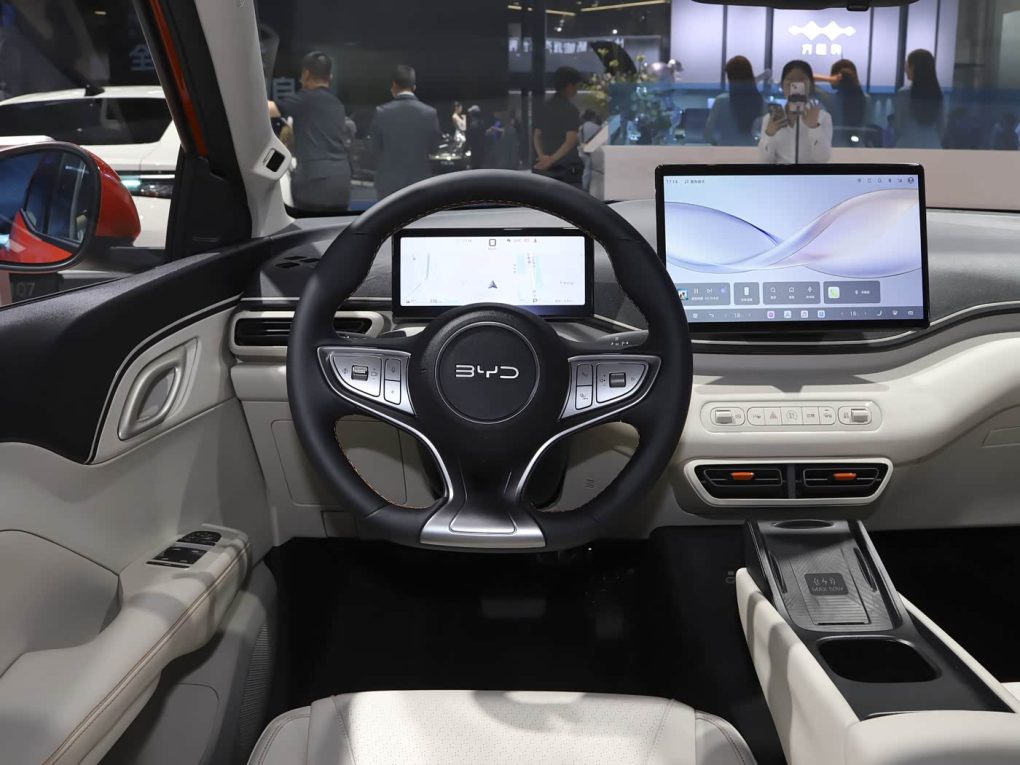
The BYD vs Tesla comparison has become the industry’s defining rivalry. While Tesla leads in profit-per-vehicle (~$4,000) and brand premium, BYD’s volume advantage (4.3M vs 1.8M units in 2024) and product breadth (from $11,000 Seagull to $150,000 Yangwang U8) demonstrate a fundamentally different strategic approach.
Challenges Ahead: The Ceiling Is Real
Despite the momentum, structural headwinds are intensifying:
-
Domestic price wars: Over 50 brands compete in a market showing saturation signals. Average transaction prices fell 12% year-over-year in 2024.
-
Profitability pressure: Most Chinese EV startups remain unprofitable; even BYD’s automotive margin compressed to 17.5% in Q3 2024.
-
Geopolitical friction: US tariffs of 100%, EU anti-subsidy investigations, and data localization requirements in key markets complicate expansion.
-
Raw material volatility: Lithium carbonate prices, while down from 2022 peaks, remain cyclical, impacting cost predictability.
Frequently Asked Questions
Q: What percentage of global EV sales does China account for? A: As of 2025, China represents approximately 62% of global electric vehicle sales, including both BEVs and PHEVs.
Q: Is BYD bigger than Tesla now? A: In terms of unit sales volume, yes. BYD delivered 4.27 million NEVs in 2024 versus Tesla’s 1.79 million. However, Tesla maintains higher revenue per vehicle and profit margins.
Q: What makes Chinese EV batteries better? A: Chinese manufacturers lead in cost efficiency (30-40% lower than Western alternatives), safety innovations (LFP chemistry advancements), and vertical integration from raw materials to pack assembly.
Q: Can Chinese EV brands succeed in the US market? A: Current 100% US tariffs effectively block direct Chinese EV imports. Success would require local manufacturing or joint ventures, neither of which is imminent for major Chinese brands.
Conclusion
China’s electric vehicle industry has transitioned from policy-driven experiment to market-validated global force. The combination of manufacturing scale, battery cost leadership, and software integration creates a competitive moat that will define automotive competition through 2030.
However, the transition from volume leader to profit leader—and from domestic champion to trusted global brand—remains the critical challenge. For international stakeholders, the question is no longer whether China EV sales will lead globally, but how that leadership will reshape the economics of mobility itself.